From The Day of the Locust:
"It's hard to laugh at the need for beauty and romance, no matter how tasteless, even horrible, the results of that are. But it is easy to sigh. Few things are sadder than the truly monstrous" (24).
Thursday, September 21, 2006


Tuesday, September 19, 2006
The Death of Reading, Deferred
After emailing the writer of the piece I blogged below, I received this email today, and I feel a bit better, though I think that, if it was truly intended to be a satire it could have been done more effectively. But at least I'm one of the people who got "extra points" for asking him whether it was something along the lines of "A Modest Proposal"!
Dear Practical Futurist reader,
I prefer to correspond with my readers more personally, but I received so much email on the “Worth of Reading” column that I must resort to a group mailing.
As a writer, I deeply appreciate how many of you came to the defense of reading—even if it involved some fairly harsh words aimed at me. But I need to point out that the dateline on the article was December 25, 2025.
In other words, the entire piece was written as a commentary from the future, so the story is fictional, depicting an outcome and attitude that as a writer I dearly hope doesn't transpire (but sometimes fear we may be heading toward).
I've received more than 500 emails on this column, about 80% horrified by "my" attitude. The other 20% of the readers recognized that the piece was hypothetical and satirical, set in 2025 (and they got extra points if they mentioned a conceptual similarity to Jonathan Swift’s “A Modest Proposal.”) Distressingly, those were also the readers who agreed that if American literacy, especially among the young, continues on its current course, the dreadful outcome I imagined might not be far from the truth.
Let’s hope not! Here’s to many more decades of happy and fluent readers yet to come—
Michael R.
Michael Rogers
http://www.practicalfuturist.com/
on MSNBC.com
Dear Practical Futurist reader,
I prefer to correspond with my readers more personally, but I received so much email on the “Worth of Reading” column that I must resort to a group mailing.
As a writer, I deeply appreciate how many of you came to the defense of reading—even if it involved some fairly harsh words aimed at me. But I need to point out that the dateline on the article was December 25, 2025.
In other words, the entire piece was written as a commentary from the future, so the story is fictional, depicting an outcome and attitude that as a writer I dearly hope doesn't transpire (but sometimes fear we may be heading toward).
I've received more than 500 emails on this column, about 80% horrified by "my" attitude. The other 20% of the readers recognized that the piece was hypothetical and satirical, set in 2025 (and they got extra points if they mentioned a conceptual similarity to Jonathan Swift’s “A Modest Proposal.”) Distressingly, those were also the readers who agreed that if American literacy, especially among the young, continues on its current course, the dreadful outcome I imagined might not be far from the truth.
Let’s hope not! Here’s to many more decades of happy and fluent readers yet to come—
Michael R.
Michael Rogers
http://www.practicalfuturist.com/
on MSNBC.com
Monday, September 18, 2006
The Worth of Words
I just read one of the most disturbing things ever -- a case against the significance of reading, and in support of reading literacy going by the wayside over the next two decades. Please, someone, tell me whether this is satire -- something along the lines of Swift's "A Modest Proposal," though not nearly as well done -- or whether this is real.
Strangely, I'm much more comfortable contemplating my own eventual physical death than I am pondering the possibility of the twin deaths of literature and reading.
Strangely, I'm much more comfortable contemplating my own eventual physical death than I am pondering the possibility of the twin deaths of literature and reading.
Thursday, September 14, 2006
Rabbis Ordained in Germany
Today, in Germany, the first rabbi was ordained since 1942.
"After the Holocaust, many people could never have imagined that Jewish life in Germany could blossom again," said German President Horst Koehler before the event. "That is why the first ordination of rabbis in Germany is a very special event indeed."
Read about it in the Washington Post.
"After the Holocaust, many people could never have imagined that Jewish life in Germany could blossom again," said German President Horst Koehler before the event. "That is why the first ordination of rabbis in Germany is a very special event indeed."
Read about it in the Washington Post.
Sunday, September 10, 2006
For All Eyes Only
In the New York Times this morning you can read some of Susan Sontag's journal entries, and though it felt a bit weird to be reading what someone has presumably written to herself, Sontag herself claims that journals are written "precisely to be read furtively by other people." I'm not sure I agree with that, but it made me feel better as I read on.
A couple things I liked or found interesting:
"The fear of becoming old is born of the recognition that one is not living now the life that one wishes. It is equivalent to a sense of abusing the present." Now that rings true -- how else can I explain what I experience as my impending doom (turning 30 next year)?
"It’s corrupting to write with the intent to moralize, to elevate people’s moral standards." Not entirely sure I agree with this, but it's interesting to consider.
"A freshly typed manuscript, the moment it’s completed, begins to stink. It’s a dead body — it must be buried — embalmed, in print."
A couple things I liked or found interesting:
"The fear of becoming old is born of the recognition that one is not living now the life that one wishes. It is equivalent to a sense of abusing the present." Now that rings true -- how else can I explain what I experience as my impending doom (turning 30 next year)?
"It’s corrupting to write with the intent to moralize, to elevate people’s moral standards." Not entirely sure I agree with this, but it's interesting to consider.
"A freshly typed manuscript, the moment it’s completed, begins to stink. It’s a dead body — it must be buried — embalmed, in print."
Monday, September 04, 2006
Broken World
"Holiness is not a competition, but a call to everyone to transcend self-absorption and participate in the healing of our broken world."
I read this line this morning in a letter from a Catholic nun to the New York Times. Sounds a lot like tikkun olam. How nice it would be if this concept, which is in theory at the heart of both Judaism and Christianity (Protestantism and Catholocism), was all we needed.
I read this line this morning in a letter from a Catholic nun to the New York Times. Sounds a lot like tikkun olam. How nice it would be if this concept, which is in theory at the heart of both Judaism and Christianity (Protestantism and Catholocism), was all we needed.
Saturday, September 02, 2006
The Devil Made Me Do It
As a fervent lover of the Hebrew bible, and speaking from a long history of exposure to Christianity, I have always had an ambivalent relationship with the New Testament's Paul. But in some instances, I have to admit that he gets at the complexity of being human:
"For that which I do I allow not: for what I would, that do I not; but what I hate, that do I" (Rom. 7:15).
Considering how frustrated I am with myself from time to time, I thought of this verse this morning and searched for it. I can relate with this verse. But then it gets a bit out of the realm of what I consider acceptable:
"Now then it is no more I that do it, but sin that dwelleth in me. For I know that in me (that is, in my flesh) dwelleth no good thing: for to willis present with me; but how to perform that which is good I find not . . . Now if I do that I would not, it is no more I that do it, but sin that dwelleth in me" (Rom 7:17-18, 20).
I know what Paul is getting at, but my fear is that it opens up a space in which people can too easily place blame on somebody, or something, else -- to say, metaphorically speaking, "the devil made me do it." Though I would love to blame "the devil" for many of my actions, I fear that I am always already responsible for them.
I suppose, though, that this is a valiant effort on Paul's part to explore the complexity of being human, and the potential for conflicting emotions and desires.
"For that which I do I allow not: for what I would, that do I not; but what I hate, that do I" (Rom. 7:15).
Considering how frustrated I am with myself from time to time, I thought of this verse this morning and searched for it. I can relate with this verse. But then it gets a bit out of the realm of what I consider acceptable:
"Now then it is no more I that do it, but sin that dwelleth in me. For I know that in me (that is, in my flesh) dwelleth no good thing: for to willis present with me; but how to perform that which is good I find not . . . Now if I do that I would not, it is no more I that do it, but sin that dwelleth in me" (Rom 7:17-18, 20).
I know what Paul is getting at, but my fear is that it opens up a space in which people can too easily place blame on somebody, or something, else -- to say, metaphorically speaking, "the devil made me do it." Though I would love to blame "the devil" for many of my actions, I fear that I am always already responsible for them.
I suppose, though, that this is a valiant effort on Paul's part to explore the complexity of being human, and the potential for conflicting emotions and desires.
Tuesday, August 29, 2006
Levinas and Poe's Raven
I'm sitting in on an Emmanuel Levinas class this semester, simply for personal edification. And in reading his Existence and Existents (written while he was a prisoner of war) for the first time, I'm amazed at how largely the concept of the "there is" figures into Levinas's early, pre-Totality and Infinity work. There is not, however, any trace of what will become the fundamentally Levinasian notion of the face-to-face. But it's filled with literary references and illusions -- Rimbaud, Shakespeare, Racine, Baudelaire, Homer, Blanchot -- that, for me, ground an otherwise dense work. One subtle reference to Edgar Allen Poe is particularly intriguing, and must have been personally resonant for Levinas, as he sat as a prisoner of war:
"If death is nothingness, it is not nothingness pure and simple; it still has the reality of a chance that was lost. The 'nevermore' hovers about like a raven in the dismal night, like a reality in nothingness. The incompleteness of this evanescence is manifest in the regret which accompanies it. . . " (77).
Even death, it seems, for Levinas, is too nuanced to be simply "nothingness."
"If death is nothingness, it is not nothingness pure and simple; it still has the reality of a chance that was lost. The 'nevermore' hovers about like a raven in the dismal night, like a reality in nothingness. The incompleteness of this evanescence is manifest in the regret which accompanies it. . . " (77).
Even death, it seems, for Levinas, is too nuanced to be simply "nothingness."
Monday, August 21, 2006
Dining With Hitler
I just read a short article about a new restaurant that opened in India called Hitler's Cross, named after Adolf Hitler and promoted with posters showing the German leader and Nazi swastikas. India's small Jewish community, of course, is outraged.
“This place is not about wars or crimes, but where people come to relax and enjoy a meal,” said restaurant manager Fatima Kabani, adding that they were planning to turn the eatery’s name into a brand with more branches in Mumbai.
“We wanted to be different. This is one name that will stay in people’s minds,” owner Punit Shablok told Reuters. “We are not promoting Hitler. But we want to tell people we are different in the way he was different.” Different? Not the word I would use to describe Hitler, or this restaurant.
Now, seriously. I can't even comment on this creepy brand of anti-Semitism.
“This place is not about wars or crimes, but where people come to relax and enjoy a meal,” said restaurant manager Fatima Kabani, adding that they were planning to turn the eatery’s name into a brand with more branches in Mumbai.
“We wanted to be different. This is one name that will stay in people’s minds,” owner Punit Shablok told Reuters. “We are not promoting Hitler. But we want to tell people we are different in the way he was different.” Different? Not the word I would use to describe Hitler, or this restaurant.
Now, seriously. I can't even comment on this creepy brand of anti-Semitism.
Sunday, August 20, 2006
The Corruptibility of Günter Grass
Today's New York Times has two op-ed pieces on the unfortunate revelation of Günter Grass's sordid Nazi background: Daniel Kehlmann's "A Prisoner of the Nobel" and Peter Gay's "The Fictions of Günter Grass." As if being any kind of Nazi isn't bad enough, Grass was apparently part of the Waffen SS, who played a particularly ugly role in the Holocaust. Kehlmann's piece raises an interesting point:
"His participation in Hitler’s elite corps could have been seen as youthful foolishness, but his silence over so many years is another matter. And naturally, there are consequences for Germany’s image in the world. When even the most outspoken German moralist wore the uniform of murderers, one might ask whether there is a single guiltless German in this generation."
In the world of Levinasian ethics one might say that Grass is doubly responsible for his role in the Holocaust: first for the direct action, and second for his concealment of that action -- the concealment of the action continues and extends it, perpetuates its legacy. Both articles point out that had Grass come forward about his past in 1959 after the publication of The Tin Drum, perhaps he could now retain some of his well-deserved literary respect. But clearly we will never view Grass, newly Nobel prize-less, in the same way.
"His participation in Hitler’s elite corps could have been seen as youthful foolishness, but his silence over so many years is another matter. And naturally, there are consequences for Germany’s image in the world. When even the most outspoken German moralist wore the uniform of murderers, one might ask whether there is a single guiltless German in this generation."
In the world of Levinasian ethics one might say that Grass is doubly responsible for his role in the Holocaust: first for the direct action, and second for his concealment of that action -- the concealment of the action continues and extends it, perpetuates its legacy. Both articles point out that had Grass come forward about his past in 1959 after the publication of The Tin Drum, perhaps he could now retain some of his well-deserved literary respect. But clearly we will never view Grass, newly Nobel prize-less, in the same way.
Monday, August 14, 2006
Learning About the Holocaust in Iran
Today the Holocaust cartoon exhibit opened in Tehran, Iran. I still haven't figured out how this is an acceptable response to the Danish cartoon of the Prophet Muhammad nearly a year ago. Apparently 50 people attended the exhibit today, and one 23-year-old woman remarked: "I came to learn more about the roots of the Holocaust and the basis of Israel's emergence."
I nearly choked on a piece of candy I was eating when I read that. Since when can one learn anything truthful about Israel, Jews, or the Holocaust in an Islamic country, particularly one whose president has essentially called the Holocaust a fiction? It would be like going to the Duke Lacrosse team for lesson on diversity and how to treat women.
I nearly choked on a piece of candy I was eating when I read that. Since when can one learn anything truthful about Israel, Jews, or the Holocaust in an Islamic country, particularly one whose president has essentially called the Holocaust a fiction? It would be like going to the Duke Lacrosse team for lesson on diversity and how to treat women.
Friday, August 11, 2006
The Rhetoric of Denim
I knew that denim had a scholarly purpose. This looks like an interesting read.
Sunday, August 06, 2006
Busy Times
I'm sorry that there has been no action around here lately. I'm still in the process of moving, and planning my syllabus, and studying Italian, and . . . but I'll be back soon.
Saturday, July 29, 2006
Spinoza and Doubt
Today Rebecca Goldstein has an interesting op-ed essay ("Reasonable Doubt") in the New York Times. It is partially in commemoration of the "350th anniversary of the excommunication of the philosopher Baruch Spinoza from the Portuguese Jewish community of Amsterdam in which he had been raised." The essay brings Spinoza's life and thought into the context of today's (this past week's) international events. It's a good essay.
But it also occurs to me that nothing, or at least very little, is "true" beyond "reasonable doubt." My ideas about God and religion, as unwaveringly right as they might feel to me, are still susceptible to the voice of reason. I'm not sure whether this is a scary or liberating concept.
But it also occurs to me that nothing, or at least very little, is "true" beyond "reasonable doubt." My ideas about God and religion, as unwaveringly right as they might feel to me, are still susceptible to the voice of reason. I'm not sure whether this is a scary or liberating concept.
Wednesday, July 26, 2006
Not Christian, Jew, or Muslim
This video clip from Al-Jazeera is stunning, though I fear that this woman is going to need some serious protection from the world of Islamic fundamentalism. After watching this video the prospect of secularism as opposed to monotheism is inviting.
You must watch this video.
You must watch this video.
Wednesday, July 19, 2006
The Temptation of Violence
I've come to realize that what concerns me most -- and inevitably hovers over my dissertation and all other academic scholarship -- are theological questions. Like most people, I want answers. But unlike many people, I've grown more content with the knowledge that often the "answer" is merely one more explosion of unanswerable questions and unsolvable conundrums. And yet, driven by an intellectual era dominated by postsecular concerns, I still work, study, read, and write in a "find the answer" mode. Perhaps this is one reason I am so drawn to Judaism (perhaps instead I should say Jewish thought, or even Jewish ethical monotheism) -- the insistence that the experience of working toward or looking for "answers" is more significant than what we actually hope to find as a result of our inquisitive endeavors. It is a dynamic ethical system, capable of continually and subtly evolving past what others conceive of as an outdated, monolithic set of rules and guidelines.
Tonight in particular I was thinking about the ways that some people use biblical principles and scriptures to indirectly insult, and essentially assault, others. The bible has become a weapon of sorts -- a sword brandished high above the heads of those who fear that their own theological foundations are too shaky to allow for the inclusion of those who don't believe exactly as they do. Ironically, however, when I was young I remember sitting in Sunday school (I was raised in a very conservative Christian home and community), and being told that I should put on the full armor of God, and that the bible was my sword (this metaphorical rendering comes from Paul's letter to the Ephesians). We even engaged in little contests that were called Sword Drills, in which we would race to see who could look up a scripture verse first. Is it any wonder that so many people are conditioned to utilize the bible and its contents and interpretations as if it is indeed a deadly weapon? But despite the seeming rhetoric of violence, the New Testament writers (one in particular) admonish people to live peaceably with one another.
I am not in any way saying that there are not truths to be found in the Christian New Testament --- quite the contrary. The world would be a wonderful place if all Christians were Christ-like. I just find the violent imagery and metaphors fascinating, especially in the wake of such a hideous historical misuse of the bible.
One of my younger brothers was especially shrewd when it came to strategically using the bible as a "weapon." When he was in fifth or sixth grade, he perused the New Testament for any verses that could be construed to be anti-women or mysogynist (there are quite a few, to be sure, particularly in the Pauline epistles), and then he wrote them all down on tiny scraps of paper, which he kept in the pockets of his Levi's jeans. There was another little girl from our church who apparently annoyed him, and so when she pushed him too far, he would whip out the scraps of paper and unleash a slew of biblically charged insults. A hilarious family anecdote, to be sure, but it's somewhat disturbing.
Likewise, it was not uncommon among people in the Christian college community in which I lived during my undergraduate years to hurl scriptures at people in disagreements as a way to hurt or somehow incriminate the other person. These were also more often than not the most vicious and hypocritical people.
And now, tonight, I'm again looking at Emmanuel Levinas's "The Temptation of Temptation," in which he recalls the Talmudic story (Tractate Shabbath) of a Sadducee who came upon Raba, who was so buried in Torah study, that as he sat absentmindedly rubbing his heel, blood began to spurt from it. This story is the starting point for my dissertation, and I never cease to be fascinated by its implications, primarily that Torah study (or bible or any other text, I would argue) is always accompanied by a necessary violence -- that the violence is necessary in order to wrest from the text the meaning that is concealed. I also can't help but think of Rene Girard's Violence and the Sacred here.
There's no way out of violence, it seems, and this imperative becomes even more profound in the context of spiritual and theological inquiry.
Tonight in particular I was thinking about the ways that some people use biblical principles and scriptures to indirectly insult, and essentially assault, others. The bible has become a weapon of sorts -- a sword brandished high above the heads of those who fear that their own theological foundations are too shaky to allow for the inclusion of those who don't believe exactly as they do. Ironically, however, when I was young I remember sitting in Sunday school (I was raised in a very conservative Christian home and community), and being told that I should put on the full armor of God, and that the bible was my sword (this metaphorical rendering comes from Paul's letter to the Ephesians). We even engaged in little contests that were called Sword Drills, in which we would race to see who could look up a scripture verse first. Is it any wonder that so many people are conditioned to utilize the bible and its contents and interpretations as if it is indeed a deadly weapon? But despite the seeming rhetoric of violence, the New Testament writers (one in particular) admonish people to live peaceably with one another.
I am not in any way saying that there are not truths to be found in the Christian New Testament --- quite the contrary. The world would be a wonderful place if all Christians were Christ-like. I just find the violent imagery and metaphors fascinating, especially in the wake of such a hideous historical misuse of the bible.
One of my younger brothers was especially shrewd when it came to strategically using the bible as a "weapon." When he was in fifth or sixth grade, he perused the New Testament for any verses that could be construed to be anti-women or mysogynist (there are quite a few, to be sure, particularly in the Pauline epistles), and then he wrote them all down on tiny scraps of paper, which he kept in the pockets of his Levi's jeans. There was another little girl from our church who apparently annoyed him, and so when she pushed him too far, he would whip out the scraps of paper and unleash a slew of biblically charged insults. A hilarious family anecdote, to be sure, but it's somewhat disturbing.
Likewise, it was not uncommon among people in the Christian college community in which I lived during my undergraduate years to hurl scriptures at people in disagreements as a way to hurt or somehow incriminate the other person. These were also more often than not the most vicious and hypocritical people.
And now, tonight, I'm again looking at Emmanuel Levinas's "The Temptation of Temptation," in which he recalls the Talmudic story (Tractate Shabbath) of a Sadducee who came upon Raba, who was so buried in Torah study, that as he sat absentmindedly rubbing his heel, blood began to spurt from it. This story is the starting point for my dissertation, and I never cease to be fascinated by its implications, primarily that Torah study (or bible or any other text, I would argue) is always accompanied by a necessary violence -- that the violence is necessary in order to wrest from the text the meaning that is concealed. I also can't help but think of Rene Girard's Violence and the Sacred here.
There's no way out of violence, it seems, and this imperative becomes even more profound in the context of spiritual and theological inquiry.
Thursday, July 13, 2006
I Could Be A Physician By Now, Right?
I just had a great big laugh. Yesterday I emailed an old girlfriend from college. Although we haven't spoken for years (a falling out of sorts), we used to be quite good friends, and so I thought it would be nice to send her a brief note to say hello. In my letter, I wrote that I was still in Indiana, but almost finished with my PhD. I remarked on the cold winters here. Then I wished her well, and told her I would love to hear what's going on in her life.
Her surprising reply (in part) reads as follows:
"Oh my gosh, Mon! You're in Indiana? And still in school?? I can't even begin to comprehend how much time you've spent in classes - you realize you could be a physician by now, right? You're probably either crazy or highly intelligent (likely the latter) . . . oh, and we live right by South Coast Plaza [Orange County, California] which I can report has absolutely lovely winters. And summers, and springs, so try to get hired on the west coast if at all possible. Hey... I'll bet Victorville Community College is hiring! Yes, it's perfect."
Now, first of all, why is it that some people still conceive of an MD as the most prestigious degree? Why should it matter that I could have been a physician by now? Wouldn't I have done that if I had been so inclined? It is as if she is saying, "What a shame you won't have anything better to show for all these years of classes other than a silly little PhD!" And, while I am indeed both "crazy" and presumably "highly intelligent," it's clear that she wants me to know that she believes the former alone is true. And, Victorville Community College is a notoriously bad community college near my home town of Apple Valley, California (though I did take a phenomenal history class there one summer).
So, my question is, then, when did getting a PhD in English become such a waste of time?
Her surprising reply (in part) reads as follows:
"Oh my gosh, Mon! You're in Indiana? And still in school?? I can't even begin to comprehend how much time you've spent in classes - you realize you could be a physician by now, right? You're probably either crazy or highly intelligent (likely the latter) . . . oh, and we live right by South Coast Plaza [Orange County, California] which I can report has absolutely lovely winters. And summers, and springs, so try to get hired on the west coast if at all possible. Hey... I'll bet Victorville Community College is hiring! Yes, it's perfect."
Now, first of all, why is it that some people still conceive of an MD as the most prestigious degree? Why should it matter that I could have been a physician by now? Wouldn't I have done that if I had been so inclined? It is as if she is saying, "What a shame you won't have anything better to show for all these years of classes other than a silly little PhD!" And, while I am indeed both "crazy" and presumably "highly intelligent," it's clear that she wants me to know that she believes the former alone is true. And, Victorville Community College is a notoriously bad community college near my home town of Apple Valley, California (though I did take a phenomenal history class there one summer).
So, my question is, then, when did getting a PhD in English become such a waste of time?
Sunday, July 09, 2006
Home is Where the Struggles Are
Today I'm finishing a review of Janet Burstein's Telling the Little Secrets: American Jewish Writing Since the 1980s. Burstein is a really great writer, particularly for an "academic": the writing is never purposely dense or convoluted, and though it is critical writing, it is always brilliantly imaginative. Her discussion of Aryeh Lev Stollman's The Far Euphrates is especially interesting. The novel is the story of a young Jewish/Canadian boy named Alexander, who tries to recapture the ambiguous and painful memories of his childhood. The distance, loss, and separation that he associates with "home" subtly evoke the consequences of inhabiting a post-Holocaust world, particularly for a Jewish family.
But I am intrigued by Burstein's suggestion that "from the womb onward, home may be the site of our most desperate struggles -- a struggle first to receive nurture and care, then to achieve independence, and finally to assume responsibility" (108). It gives new meaning to the phrase "dysfunctional family." Dysfunction is perhaps only a symptom of home.
Now I'm going to read a bit into that quotation. In my family, as in my own life, it seems like there is always some kind of drama. Whether it's me getting into two car accidents in one month, my dad walking outside and being bitten by a deadly snake, my brothers being literally jumped by a Samoan gang, or an overly heated family debate over politics in the kitchen, there always seems to be a struggle or conflict of some sort. I've often asked myself why this is -- why our household is more action-packed than most. I have typically perceived of it as a negative (though perhaps beyond our control) phenomenon, but now I'm not so sure. I wonder if it is the existence of struggle or conflict that brings us together, makes us strong. I like Burstein's idea of home as the "site of our most desperate struggles" because it allows me to conceive of my family's predicament from a different, and more promising, perspective: my own personal family life may be full of struggles, but perhaps it's just that we know what it means to be "home," and we're comfortable being there in what it is.
But I am intrigued by Burstein's suggestion that "from the womb onward, home may be the site of our most desperate struggles -- a struggle first to receive nurture and care, then to achieve independence, and finally to assume responsibility" (108). It gives new meaning to the phrase "dysfunctional family." Dysfunction is perhaps only a symptom of home.
Now I'm going to read a bit into that quotation. In my family, as in my own life, it seems like there is always some kind of drama. Whether it's me getting into two car accidents in one month, my dad walking outside and being bitten by a deadly snake, my brothers being literally jumped by a Samoan gang, or an overly heated family debate over politics in the kitchen, there always seems to be a struggle or conflict of some sort. I've often asked myself why this is -- why our household is more action-packed than most. I have typically perceived of it as a negative (though perhaps beyond our control) phenomenon, but now I'm not so sure. I wonder if it is the existence of struggle or conflict that brings us together, makes us strong. I like Burstein's idea of home as the "site of our most desperate struggles" because it allows me to conceive of my family's predicament from a different, and more promising, perspective: my own personal family life may be full of struggles, but perhaps it's just that we know what it means to be "home," and we're comfortable being there in what it is.
Tuesday, July 04, 2006
I am an American
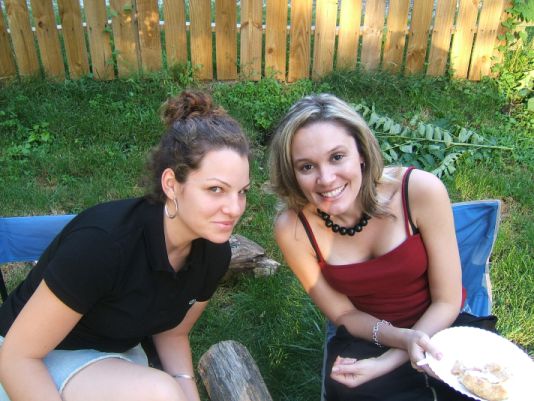
This is it -- proof that I forced myself to emerge from my dungeon today, long enough to wear a patriotic color, go to a bbq, watch people drink beer, discuss flag-burning, pretend to be happy, and eat apple pie. Today I am an American, of sorts, apparently. But now I'm back in my lair, hiding out while everyone else watches fireworks. There was only so much celebration that I could take.
Monday, July 03, 2006
A Warning Against Sun-tanning
I'm just about finished with Margaret Atwood's The Blind Assassin. It's taken me forever since I keep stopping to read other things. But I came across something very useful today.
The main character notices that her doctor is beginning to age: "...the shoe of aging is beginning to pinch," she says to herself, "Soon you'll regret all that sun-tanning. Your face will look like a testicle."
One of my loved ones is constantly imploring me to use sunscreen. I never, or rarely, listen. Perhaps if I had been told that my face would one day look like a testicle, I would have put on sunscreen. Everyday. Even in the winter. It's not a good look -- for anyone.
The main character notices that her doctor is beginning to age: "...the shoe of aging is beginning to pinch," she says to herself, "Soon you'll regret all that sun-tanning. Your face will look like a testicle."
One of my loved ones is constantly imploring me to use sunscreen. I never, or rarely, listen. Perhaps if I had been told that my face would one day look like a testicle, I would have put on sunscreen. Everyday. Even in the winter. It's not a good look -- for anyone.
Subscribe to:
Posts (Atom)


 Posts
Posts